Table of Contents
A herniated or bulging disc happens when one of the cushions between your spinal bones pushes out of place and irritates nearby nerves. Warning signs include pain that radiates into an arm or leg, numbness or tingling, weakness in a limb, and pain that worsens with sitting, coughing, or sneezing. At HealthFirst Chiropractic in Westerville and Pickerington, our doctors work to identify what is happening before the problem gets worse.
What Is a Herniated or Bulging Disc?
Between each of your spinal bones sits a soft disc that acts as a cushion and shock absorber. These discs let your spine bend and move while protecting the bones from grinding together.
A bulging disc is one that has pushed outward beyond its normal boundary, a bit like a tire with a weak spot. A herniated disc is more advanced, where the inner material breaks through the outer layer.
Both can press on or irritate nearby nerves, and that is usually where the trouble starts. The location of the disc determines where you feel the symptoms.
Warning Signs You Should Not Push Through
Disc problems often send signals that are easy to dismiss at first. Paying attention to these can help you get care before the issue deepens.
Pain That Radiates Into a Limb
When a disc irritates a nerve, the pain often travels along that nerve’s path. A disc in your lower back can send pain down the leg, while one in your neck can send it into the arm.
This radiating pain is different from a local ache. If discomfort is shooting away from your spine into a limb, a disc may be involved. In the lower back, this often shows up as sciatica.
Numbness, Tingling, or Weakness
Nerves carry sensation and control muscles, so nerve irritation can affect both. You might notice numbness, a pins-and-needles feeling, or weakness in a hand, foot, or limb.
These symptoms are worth taking seriously. They suggest the nerve is being affected, not just the muscles around your spine.
Pain That Worsens With Certain Movements
Disc pain often has clear triggers. Sitting for long periods, bending forward, coughing, or sneezing can spike the discomfort because these actions increase pressure on the disc.
If you notice your pain follows a predictable pattern like this, it is a useful clue. Mentioning these triggers to your doctor helps pinpoint the source.
When Disc Problems Become an Emergency
Most disc issues are not emergencies, but a few symptoms require immediate medical attention. These are rare, but you should know them.
Seek emergency care right away if you experience loss of bladder or bowel control, numbness in the groin or inner thigh area, or sudden severe weakness in both legs. These can signal a serious condition that needs urgent treatment.
We mention this because being honest about the warning signs matters more than being reassuring. If any of these occur, do not wait for a chiropractic appointment. Go to the emergency room.
What Causes Disc Problems
Discs can be affected by both sudden events and slow wear. Understanding the cause often helps make sense of the symptoms.
Common contributors include age-related disc changes, repetitive lifting or twisting, prolonged sitting with poor posture, and sudden trauma from a fall, sports, or an auto accident. Often it is a combination that builds over time and then reaches a tipping point.
The good news is that many disc problems respond well to conservative, non-surgical care when they are addressed properly. The first step is an accurate diagnosis.
How We Diagnose Disc Issues
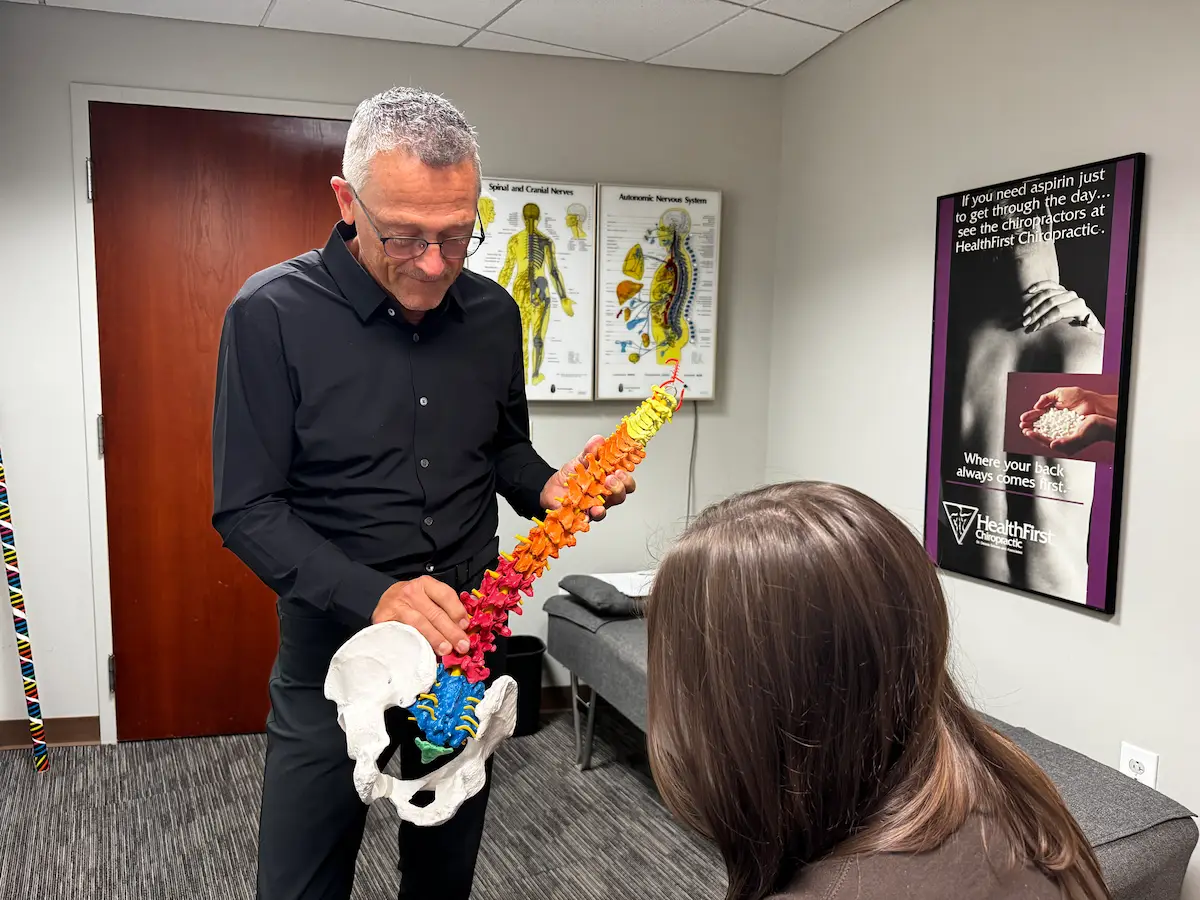
Our Gonstead approach is built to answer exactly this kind of question. On your first visit, our doctors take a full history and perform orthopedic and neurological testing to check whether a nerve is involved.
Digital X-rays, taken on-site at both our Westerville and Pickerington offices, show the structure of your spine, including disc spaces and alignment. Hands-on palpation and motion testing add detail about how each segment is moving.
On your second visit, your doctor walks you through the result of tests in plain language and explains what is actually causing your symptoms. You will understand the problem before any treatment begins.
Treatment Options Without Surgery
Many patients want to explore every option before considering surgery, and that is a reasonable goal. Conservative care helps a lot of people with disc problems.
Our chiropractic care uses precise, targeted adjustments to address joint dysfunction and support the affected area. For disc-related pain at our Pickerington office, patients may also be candidates for spinal decompression, a non-surgical therapy that gently reduces pressure on the disc.
The right approach depends on your specific situation, which is why diagnosis comes first. If surgery truly is the best answer, we will tell you and refer you appropriately.
Don’t Wait It Out
Disc problems rarely improve by ignoring them, and pushing through can sometimes make things worse. Early, accurate care gives you the best chance to avoid a longer, harder recovery.
If the warning signs above sound familiar, it is worth getting checked. You can read more about herniated and bulging discs and how we approach them at both our Westerville and Pickerington locations.
Dealing with symptoms that could point to a disc problem? Contact HealthFirst Chiropractic in Westerville at 614-890-2740, in Pickerington at 614-861-1333, or reach out online.